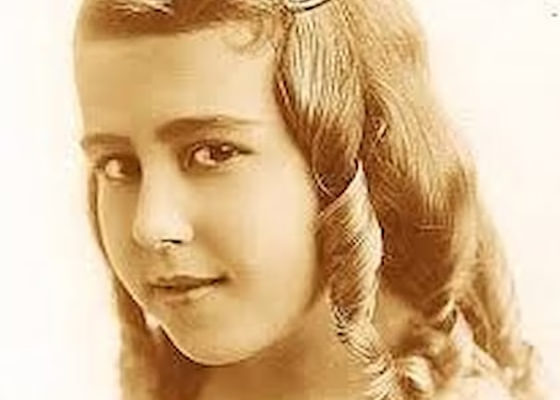
Who is baby’ carmen de?
“Baby” Carmen De Rue was an American child actress and dancer who appeared in nearly 200 Hollywood films during the 1910s, making her one of the most prolific child stars of the silent film era.
Biography of “Baby” Carmen De Rue
Born Carmen Faye DeRue on February 6, 1908, in Pueblo, Colorado, Carmen De Rue became one of the most prolific child actresses of the silent film era. Billed as “Baby” Carmen De Rue, and occasionally as Freddy DeRue, she appeared in an estimated 200 Hollywood films during the 1910s—a staggering number that places her among the busiest child stars of her time.
Her family relocated to Los Angeles when she was still a young child, a move that would shape her destiny. Her father, Eugene DeRue, was a reporter for The Los Angeles Times before transitioning into film production and direction. He is credited with pioneering sound dubbing in Hollywood, a technical innovation that would later become standard in filmmaking.
movies
Carmen’s screen debut came at the age of five, in Cecil B. DeMille’s The Squaw Man (1914), a landmark film in American cinema. From there, she became a fixture in silent shorts and feature films, often cast in fairy-tale roles or as precocious children in domestic dramas. Her credits include:
- Going Straight (1916)
- A Sister of Six (1916)
- The Babes in the Woods (1917)
- The Girl with the Champagne Eyes (1918)
- Fan Fan (1918)
She also starred in the Fox “Kiddies” series and Franklin’s “Triangle Kiddies”, which were popular child-focused productions of the time.
Despite her success, Carmen’s career slowed as she reached adulthood. Like many child stars of the silent era, she struggled to transition into mature roles. She attempted a comeback in 1925, managed by Ben H. Rothwell, but the effort didn’t reignite her film career. Instead, she turned to professional dancing, performing in stage productions and possibly vaudeville circuits.
Carmen retired from public life in the 1930s, though she remained connected to the entertainment world through her family. She passed away on September 28, 1986, in North Hollywood, California, at the age of 78, following a heart attack.
Family of Carmen De Rue
Carmen was born to Eugene DeRue and Grace Butner. Her father’s influence in Hollywood was significant—not only did he help launch her career, but he also contributed to the technical evolution of sound in film. Eugene’s legacy as a director and innovator is still noted in film history circles.
Carmen’s first marriage was to Harold Bjorgo, a grocery store owner in Eagle Rock, California, in 1928. The marriage was short-lived and ended in divorce a year later. She later married Fred Vincent Schrott in 1934, and they remained together until his death in 1959.
Carmen and Fred had children, and her known descendant is Stephen Schrott, her grandson, who has been publicly identified in biographical records. While little is known about Stephen’s life or career, his mention suggests that Carmen’s legacy continues through her family line.
There are no public records of other children or extended family members, and Carmen herself maintained a relatively private life after leaving the spotlight. Her discretion was likely intentional, given the intense scrutiny child stars often face.
Ethnicity and Cultural Identity
Carmen De Rue was an American of ethnic European origin and she was born in Colorado of parents of European descent. Although no specifics of her kinship are known, her surname which was DeRue Implies that she might have French or Belgian origins but this is just a speculation.
She was part of the ethnic majority in the white America of the early 20th century, and her roles were very much related to the then cultural dictums and aesthetics. She was portrayed in fairy-tale and domestic characters which fit the ideal Hollywood silent-era perception of childhood, innocent, whimsical, sentimental.
The fact that Carmen grew up in Los Angeles, the early years of the Hollywood industry, and the center of a fast-paced cultural industry was born was at the center of her life. Her onscreen presence contributed to developing the visual language in the early American cinema. Particularly, in representing childhood as a realm of wonder and ethical purity.
The innovative contribution of her father to sound dubbing also indicates the family occupation with film production in terms of technical and artistic side. This is an artistic and technological inheritance. It entitles Carmen De Rue to a distinctive place in the history of the Hollywood cinema.
Legacy
Though largely forgotten by mainstream audiences today, Carmen De Rue’s contribution to silent film remains significant. Appearing in nearly 200 films before the age of 18, she helped define the role of children in early cinema and paved the way for future generations of young performers.
Her story is also a reminder of the fleeting nature of fame, especially for child actors. From dazzling debuts to quiet retirements, Carmen’s life reflects both the glamour and the challenges of early Hollywood.
