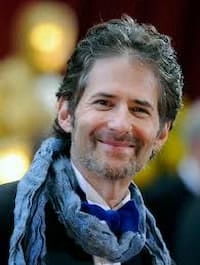
Who is James Horner?
James Roy Horner was an American composer, conductor, and orchestrator best known for his emotionally resonant film scores. With a career spanning nearly four decades, Horner composed music for over 160 films, blending traditional orchestration with choral and electronic elements.
His signature style often included Celtic motifs and sweeping melodies that elevated cinematic storytelling. He won two Academy Awards for his work on Titanic and remains one of the most celebrated composers in Hollywood history.
James Horner Biography
Born on August 14, 1953, in Los Angeles, California, Horner began playing piano at age five. He studied at the Royal College of Music in London under György Ligeti before returning to the U.S. to earn degrees from USC and UCLA, including a doctorate in music composition and theory.
Horner’s big break came in 1982 with Star Trek II: The Wrath of Khan, which showcased his ability to craft bold, thematic scores. He went on to compose for iconic films such as Braveheart, Apollo 13, Avatar, Field of Dreams, and A Beautiful Mind. His score for Titanic (1997) became the best-selling orchestral soundtrack of all time, and the song “My Heart Will Go On” won him an Oscar and a Grammy.
James Horner Family
James Horner was born into a creative and artistic family. His father, Harry Horner, was an Academy Award-winning set designer and art director. His mother, Joan Ruth Frankel, came from a Canadian musical background. Horner’s upbringing was steeped in the arts, which deeply influenced his musical path.
James Horner Wife
James Horner was married to Sara Elizabeth Nelson. The couple shared a close and supportive relationship throughout his life. Sara played a vital role in preserving his legacy after his passing, including donating his personal archive to UCLA.
James Horner Age
James Horner was 61 years old at the time of his death. He was born in 1953 and passed away in 2015, just shy of his 62nd birthday.
James Horner Anniversary
While specific details about his wedding anniversary are private, Horner and Sara were married in June 1985, and remained together until his death in June 2015, marking 30 years of marriage.
James Horner Net Worth
At the time of his death, James Horner’s net worth was estimated at $15.1 million. His wealth stemmed from decades of composing for blockbuster films, royalties from soundtracks, and collaborations with top directors like James Cameron and Ron Howard.
James Horner Death
James Horner tragically died on June 22, 2015, in a plane crash near Santa Barbara, California. He was piloting his Short Tucano turboprop aircraft when it went down in the Los Padres National Forest. His death shocked the film and music communities, and tributes poured in from around the world.
James Horner Cause of Death
The official cause of death was blunt force trauma resulting from the crash. The NTSB investigation revealed contributing factors including low-altitude maneuvering and possible impairment from prescribed medications. The crash was ruled an accident.
James Horner Children
Horner had two daughters, Emily and Becky Horner, with his wife Sara. He was known to be a devoted father, often crediting his family’s support as essential to his success.
James Horner Parents
His father, Harry Horner, was born in Holice, Czech Republic, and emigrated to the U.S. in 1935. He won two Academy Awards for art direction. His mother, Joan Ruth Frankel, was Canadian-born and musically inclined. Their influence helped shape James’s artistic sensibilities from a young age.
James Horner Brother
Horner’s brother, Christopher Horner, is a scenic designer, writer, and documentary filmmaker. Christopher has worked on films like The Jazz Singer and directed environmental documentaries such as The Disappearing of Tuvalu. The brothers shared a creative bond rooted in storytelling and visual arts.
James Horner Movies and Tv shows
| Title | Year | Type | Notes |
|---|---|---|---|
| Titanic | 1997 | Film | Won 2 Oscars; iconic score & “My Heart Will Go On” |
| Avatar | 2009 | Film | Sci-fi epic; highest-grossing film at the time |
| Braveheart | 1995 | Film | Historical drama; Oscar-nominated score |
| A Beautiful Mind | 2001 | Film | Biographical drama; Oscar-nominated score |
| Apollo 13 | 1995 | Film | Space drama; Oscar-nominated score |
| The Amazing Spider-Man | 2012 | Film | Superhero reboot; dynamic action themes |
| The Mask of Zorro | 1998 | Film | Swashbuckling adventure; Latin-inspired score |
| The Rocketeer | 1991 | Film | Retro superhero film; soaring orchestration |
| Field of Dreams | 1989 | Film | Fantasy drama; ethereal and nostalgic score |
| Star Trek II: The Wrath of Khan | 1982 | Film | Sci-fi classic; bold and dramatic themes |
| Jumanji | 1995 | Film | Adventure fantasy; whimsical and suspenseful |
| The Land Before Time | 1988 | Film | Animated classic; emotional and melodic |
| The Boy in the Striped Pajamas | 2008 | Film | Holocaust drama; haunting score |
| Southpaw | 2015 | Film | Boxing drama; one of his final works |
| The Magnificent Seven | 2016 | Film | Western remake; posthumously completed |
| House of Sand and Fog | 2003 | Film | Psychological drama; Oscar-nominated score |
| The New World | 2005 | Film | Historical epic; lush and atmospheric |
| The Karate Kid | 2010 | Film | Reboot; energetic and emotional score |
| Foster’s Home for Imaginary Friends | 2000s | TV Series | Contributed music to animated episodes |
| Amazing Stories | 1980s | TV Anthology | Composed for select episodes |
